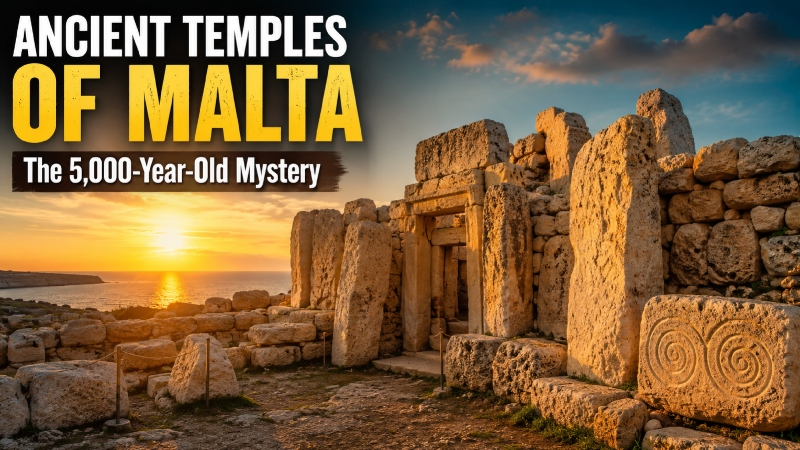
Long before the Great Pyramids rose in Egypt, a mysterious people built enormous stone temples on the tiny islands of Malta. These monuments still stand today. In fact, they are considered the oldest free-standing stone structures in the world. Then something strange happened. The builders disappeared. They left behind giant limestone blocks, underground chambers, and symbols that experts still study today.
How did Neolithic people move stones that weighed more than twenty tons? Why did they carve secret chambers underground? And what caused their civilization to vanish so suddenly? The ancient temples of Malta continue to challenge archaeologists and fascinate visitors from around the world.
Older Than the Pyramids and Stonehenge
Many people believe the Egyptian pyramids are the oldest great stone monuments. The Maltese temples are even older. Archaeologists date sites such as Ġgantija to around 3600 BC. That makes them more than a thousand years older than both Stonehenge and the Great Pyramid of Giza.
The builders had no iron tools. They shaped soft limestone with flint, stone, and bone tools. Even with simple technology, they created massive walls, curved chambers, and carefully planned entrances.
Timeline of the monuments:
- Ġgantija Temples (Gozo): 3600–3200 BC
- Stonehenge (England): around 2500 BC
- Great Pyramid of Giza (Egypt): around 2560 BC
This timeline shows just how advanced Malta’s temple builders were for their time.
The Mystery of the Giant Stones
Local legends say giants built the temples. The story sounds mythical, but the stones are truly enormous. Some blocks stand over 20 feet (6 meters) tall and can weigh up to 24 tons.
Researchers think the builders used a clever transport system. Archaeologists discovered small round stone balls near several temple sites. These may have worked like rollers, helping workers move the heavy slabs across the ground.
What experts know:
- The builders had no wheels.
- They had no metal tools.
- They likely used wooden levers, ropes, and stone rollers to move the blocks.
Even today, engineers admire the skill required to place these stones so precisely.
The Underground World of the Hypogeum
Beneath the modern streets of Malta lies one of the most unusual prehistoric sites on Earth: the Ħal Saflieni Hypogeum. This underground complex stretches across three levels carved directly into limestone. Ancient workers dug the chambers using only stone hammers and antler tools. The Hypogeum served as both a burial place and a ritual center. Archaeologists found the remains of more than 7,000 people inside its chambers.
One room, called the Oracle Chamber, has remarkable acoustic properties. A deep voice spoken inside the chamber echoes throughout the complex. Researchers believe this effect may have played a role in ancient ceremonies. The walls also contain red ochre paintings, including spirals and geometric patterns. These artworks offer a rare glimpse into the beliefs of Malta’s prehistoric people.
Temples That Follow the Sun
The temple builders understood the movement of the sun with surprising accuracy. Sites such as Ħaġar Qim and Mnajdra align with the sunrise during the spring and autumn equinoxes. On those mornings, sunlight passes through the main doorway and lights up specific stone areas inside the temple.
These alignments were not random. They likely helped ancient farmers track the seasons and decide when to plant or harvest crops. The temples may also have hosted ceremonies connected to fertility, nature, and the changing year.
Archaeologists have found:
- Carved stone altars
- Animal reliefs
- Cup marks and dot patterns that may have held ritual meaning
The temples were not just buildings. They were centres of religion, astronomy, and community life.
Why Did the Temple Builders Disappear?
Around 2500 BC, temple construction suddenly stopped. The people abandoned their sacred sites, and their culture faded from history. No written records explain what happened.
Researchers continue to investigate several possible causes:
- Climate change: A long drought may have damaged crops and reduced fresh water.
- Environmental damage: Cutting too many trees and overusing farmland could have weakened the islands’ resources.
- Disease or migration: Illness or the arrival of new groups may have changed the population.
No single theory has been proven. The disappearance remains one of the greatest mysteries in European prehistory.
What Modern Archaeologists Have Learned?
Recent studies reveal that the temple builders were highly organised. They planned large construction projects, transported huge stones, and created complex ceremonial spaces. Scientists also use 3D scanning, ground-penetrating radar, and microscopic analysis to study the temples without damaging them.
These methods continue to uncover new details about how the structures were built and used. Each discovery brings us a little closer to understanding this lost civilization.
A Mystery That Still Echoes Today
The ancient temples of Malta are more than tourist attractions. They are a reminder that sophisticated human societies existed thousands of years before the famous civilizations of Egypt and Greece. Walking through the stone passages of Ġgantija or standing inside the silent chambers of the Hypogeum feels like stepping into another world. The air is cool. The stones are ancient. And the unanswered questions remain.
Who were these builders? How did they achieve such extraordinary engineering? And why did they disappear? For now, the temples keep their secrets. That mystery is exactly what makes them one of the most fascinating archaeological wonders on Earth.