Every June, thousands of Maltese families head to Buskett Gardens with blankets, food, and a quiet sense of tradition. They come for the L-Imnarja festival, one of the oldest and most authentic cultural events still alive on the islands.
This is not a modern staged show. It is a living mix of religion, farming pride, folk music, and communal eating that has survived for centuries. If you want to understand Malta beyond the beaches and temples, this is one of the best nights to experience.
What Exactly Is L-Imnarja Festival?
L-Imnarja (pronounced lim-nar-ya) is the feast of Saints Peter and Paul, celebrated every year on 29 June. The name comes from the old word for “illumination” or lights. In earlier times, people lit fires and lamps on the walls of Mdina to honor the two apostles.
Over the centuries, the religious feast grew into something bigger. It became the farmers’ holiday after the harvest. Today it remains a public holiday and one of the strongest expressions of rural Maltese identity.
The heart of the modern celebration sits in Buskett Gardens near Rabat. This small woodland is one of the few green spaces on the main island, and for one night it turns into a giant open-air gathering.
The Deep History Behind L-Imnarja Festival
The roots go back further than the Knights of St John. Many historians link it to ancient Roman midsummer light festivals. When the Knights arrived in 1530, they adopted and expanded the existing tradition.
For ordinary Maltese people, the day carried special meaning. Rabbit hunting was normally restricted. On L-Imnarja the rules relaxed, and rabbit stew became the traditional dish of the feast. That link between rabbit and freedom still lives in the fenkata meals people share under the trees.
In the 19th century, the Agrarian Society added livestock and produce competitions. These agricultural shows remain a central part of the program today.
What Happens During L-Imnarja Festival Today?
The main action unfolds over two days, usually 28 and 29 June.
On the evening of 28 June
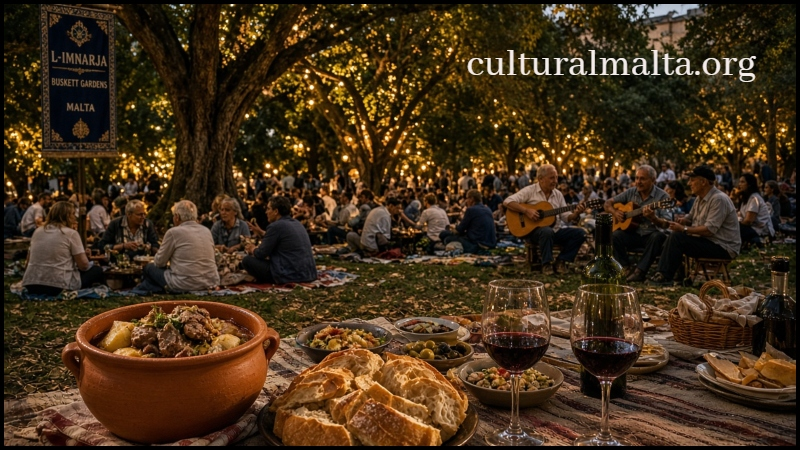
Families and groups of friends arrive at Buskett from late afternoon. They claim spots under the trees, spread tablecloths, and settle in for the night. Traditional għana singers perform, brass bands play, and people eat, talk, and listen until late.
On 29 June
The day starts early with agricultural exhibitions. You will see prize animals, fruit, vegetables, honey, and traditional carts. Later, bareback horse and donkey races take place near Saqqajja Hill. Riders compete for the traditional “palju” banners.
The atmosphere feels relaxed and family-oriented rather than commercial. Most people bring their own food, though some stalls appear in recent years.
Traditional Food at L-Imnarja Festival
Rabbit remains the star. Many groups cook or order stuffat tal-fenek (rabbit stew) or fried rabbit. People also bring pastizzi, ħobż biż-żejt, local cheese, and plenty of wine or Kinnie.
The meal is rarely formal. It is shared, slow, and social. Sitting on the ground under the trees with a pot of rabbit stew is still one of the most authentic ways to experience the night.
Practical Tips If You Want to Attend
- Arrive early on the 28th if you want a good spot under the trees.
- Bring a blanket, some food, water, and insect repellent.
- Wear comfortable shoes. Paths can be uneven and dusty.
- Public transport runs extra services, but taxis become scarce late at night. Plan your return.
- Respect the family atmosphere. This is not a loud party festival.
- Check the official program each year, as exact times for races and exhibitions can shift slightly.
Gozo also marks the feast, especially in Nadur, where Saints Peter and Paul are the village patrons. The style there feels more like a classic Maltese festa with processions and fireworks.
Why L-Imnarja Festival Still Matters?
In a country that changes quickly, L-Imnarja stays rooted. It connects modern Maltese people to their farming past, to the old woodland of Buskett, and to a night when the whole community used to gather under the stars.
For visitors, it offers something rare: a chance to sit among locals, hear real għana, taste traditional food, and feel the weight of centuries without any tourist packaging.
Final Thoughts on L-Imnarja Festival
L-Imnarja festival is quiet, deep, and unmistakably Maltese. It does not try to impress with big stages or lights. Instead, it invites you to sit down, share food, and take part in a tradition that has lasted longer than most countries.
If you are in Malta at the end of June, set aside the evening of the 28th and the morning of the 29th. Go to Buskett. Bring something to sit on. Listen more than you speak. You will leave with a clearer sense of what Maltese culture actually feels like.
Have you experienced L-Imnarja before, or are you planning to go next year? Share your thoughts or questions below. For more authentic insights into Maltese traditions, food, and heritage, keep exploring CulturalMalta.org.